
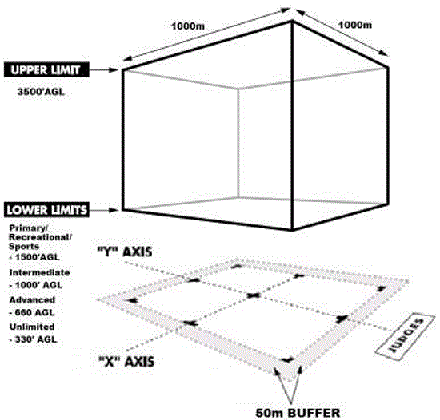
For our events, the Aerobatic Box is a 1000m x 1000m square area (in plan form) within which a single aircraft flies for competition (or practice for a competition), to an absolute low level of 100’ AGL (above ground level) for level flight or 300’AGL for aerobatic flight. Lower limits are the higher of either the pilot’s Low Level Display Authority (LLDA) or Category as follows:
- Primary, Recreational, Sports – 1500FT
- Intermediate – 660FT (200m)
- Advanced – 660FT (200m)
- Unlimited – 330FT (100m)
Note that NZAC pilots are individually authorised by NZ Warbirds to fly to minimum heights depending on their experience, which can vary from 300’AGL to 1500’AGL for aerobatics.
When selecting a location for the Aerobatic Box, the underlying criterion is always safety and in particular, the safety of non-participants below and in the near vicinity. In terms of CAA Rules, aerobatics on most occasions cannot be performed within 600 meters horizontally of a built-up area, regardless of altitude performed or if the pilot is trained, rated and current in aerobatic flight or not. For NZAC-sanctioned events, we require that a pilot has a current aerobatic rating, a minimum of a Class 2 medical (as currently prescribed by CAA), and, if flying acrobatically below 1500’AGL, they must also have an NZ Warbirds-issued Low Level Display Authorisation (LLDA). Additionally, the NZAC Contest Director can decide to exclude a pilot who is not deemed to be safe to compete, for whatever reason.
As an Aerobatic Competition (or practice for one) is deemed an Aviation Event. The Contest Organiser must obtain Event Approval (typically from NZ Warbirds), which, under CAA rules, allows for the horizontal distance from spectators or a built-up to be reduced to 220m. This reduction is in recognition of the additional skills that a competition pilot has acquired to be granted an LLDA and/or accepted for entry by the Contest Director.
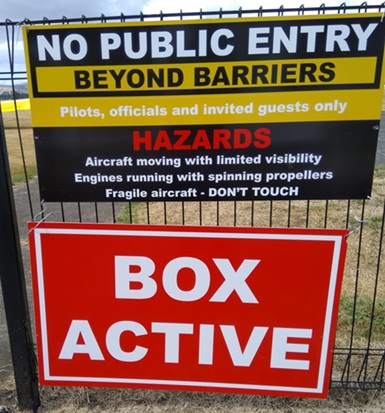
As well as complying with the Aviation Event horizontal separation rule, we purposely position the Aerobatic Box at Hood Aerodrome (Masterton) and Mercer Aerodrome so that no habitable dwellings of any nature are directly below the area, for both safety and noise nuisance reasons. Although mainly for ground observational purposes, the Aerobatic Box is immediately adjacent to the airport from which the event operates from, giving the pilots a large, unobstructed landing area to recover to following an airborne emergency or maintenance issue. The area is also chosen to be flat, free of large obstacles, at a similar level to the airport and aligned to make orientation for the pilots easy.
Due to the close proximity of the Aerobatic Box to the adjacent airport, a common radio frequency is used, enabling all proximate radio-equipped pilots to be aware of any aerobatics taking place. To further raise awareness, airport businesses/operators are also notified leading up to a competition event.

Article written by Grant Benns.
Grant has been a stalwart of the NZ Aerobatic Club for many years. He’s held many elected positions in the club including Vice President and President. Grant has competed in aircraft including Pitts S2B, ZLin 50LS, Furio, Giles G202, Vans RV6, Extra 300L, and probably a few more! Grant is responsible for many of NZ’s aerobatic pilots having instructed and type-rated many in most of the types listed. His day job has seen him flying freight ops in Fokker F27 Friendships and Boeing 737s before graduating to chauffeuring SLF in many Boeing and Airbus products. He’s currently a long-haul Boeing 787-900 captain for Air New Zealand. When not flying he can be found pedalling his wee MX5 racecar round Hampton Downs or fettling his growing car collection – a man’s gotta have toys!